

When Help Comes Too Late: A Nebraska Family’s Struggle With Mental Illness Ends in Tragedy
The town of Cozad, Nebraska, is still reeling from the loss of four cherished members of its close-knit community. What should have been a weekend of celebration — marked by a high school graduation — became a time of mourning for friends, neighbors, and loved ones who are now left with heartbreaking questions.
Authorities responded to the Koch family’s home on a quiet Saturday morning, where all four members — Bailey and Jeremy, along with their teenage sons Hudson and Asher — were found deceased. While the investigation remains ongoing, early reports suggest the incident may be connected to a long-standing mental health struggle within the family.
In the days that followed, Bailey’s parents, Lane and Peggy Kugler, stepped forward to share their story. Not to focus on the circumstances of the loss, but to shine a light on something they say needs urgent national attention: the lack of accessible, consistent, and timely mental health care in the United States.
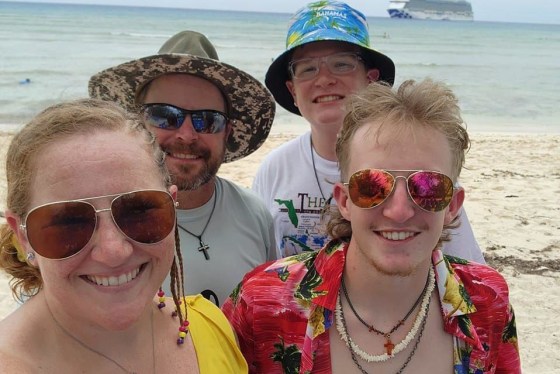
A Family Once Full of Hope
Bailey and Jeremy Koch were known to many in their community. Friends described them as kind, committed, and deeply spiritual. They were active members of their church, supportive parents to their teenage sons, and advocates for mental health awareness.
The couple had been transparent about their journey, even documenting it through a Facebook page titled Anchoring Hope for Mental Health. In post after post, Bailey spoke openly about her husband’s struggles, the steps they were taking to seek help, and her unwavering belief that healing was possible.

Just days before the tragedy, Bailey shared hopeful news: Jeremy had recently been released from a mental health facility, and they had signed paperwork to begin a new treatment regimen.
“We feel heard, seen, and supported,” she wrote. “We feel confident that this is the right direction.”
But behind those hopeful words was a family carrying an invisible weight — one that they had tried, again and again, to put down with the help of a mental health system they believed in, but that ultimately did not act fast enough.
When the System Fails Families in Crisis
In a joint statement, Bailey’s parents made it clear: the situation was not caused by a lack of love, effort, or faith. They described Jeremy’s condition as a serious mental health illness — one that had escalated from depression to psychosis over time.
“Jeremy had been fighting mental illness for many years,” they wrote. “This was not Jeremy. This was a diseased mind, not the man we knew.”
They noted that Bailey had lived for years in fear of losing her husband to his condition — not only physically, but emotionally. She had advocated for him fiercely, often documenting her frustration with how difficult it was to access sustained care, especially in smaller communities.
The family’s public plea is not for blame, but for action. In their words:
Barriers to Mental Health Care: A National Pattern
Unfortunately, the Koch family’s experience is not unique.
Across the United States, families often face overwhelming challenges when trying to navigate the mental health care system. From long wait times to insurance limitations, from provider shortages to rural inaccessibility, the system leaves many people untreated — sometimes for months, sometimes forever.
In Nebraska, as in many rural states, the availability of psychiatrists, counselors, and inpatient care facilities is limited. For serious conditions such as clinical depression or psychotic disorders, the lack of early intervention and sustained monitoring can lead to instability.
A 2023 report by the National Alliance on Mental Illness (NAMI) found that over 50% of adults with a mental health condition in the U.S. received no treatment in the previous year. In rural areas, that number was even higher.
A Mother’s Fight for Her Family

Bailey’s Facebook posts reveal a woman who never gave up.
In April, she wrote about the setbacks: the hospitalizations, the gaps in coverage, the moments when treatment seemed out of reach. She questioned why access to mental health care — something so vital — required such persistence, money, and paperwork.